Why the socket matters as much as the torn labrum
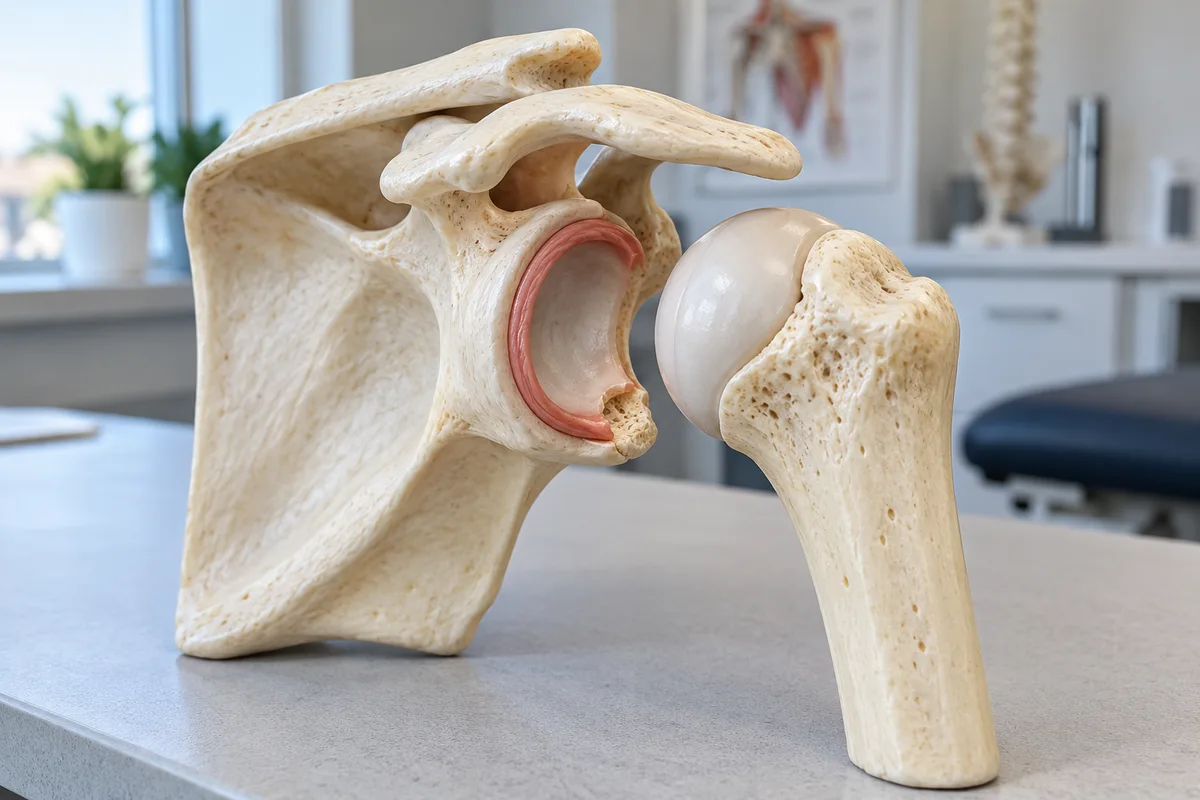
A shoulder that repeatedly slips out may have more than a torn ligament or labrum. Dislocation can also damage the bony edge of the socket. This matters because repairing soft tissue does not replace missing bone. Understanding glenoid bone loss helps explain why an apparently similar injury can require a different operation in two patients.
This article focuses on recurrent anterior shoulder instability. A previous dislocation does not automatically mean surgery is necessary, and bone loss does not make one procedure right for everyone.
What is glenoid bone loss?
The glenoid is the shallow socket in the shoulder blade. Its rim, the surrounding labrum, capsule and muscles work together to keep the upper arm bone centred. During a dislocation, part of the front socket edge may fracture or gradually wear away after repeated episodes.
A Bankart lesion usually describes separation of the labrum from the front-lower socket. A bony Bankart injury includes a bone fragment. These related injuries are not interchangeable. The AAOS guide to chronic shoulder instability explains why both ligament damage and bone injury may need attention.
Why can Bankart repair alone be insufficient?
Bankart repair reattaches the detached labrum and restores tension to supporting tissues. It can be appropriate when bone loss is limited and other recurrence risks are acceptable. However, if the socket has lost meaningful support, repairing the labrum alone may leave the underlying mechanical problem unresolved.
A systematic review of isolated Bankart repair examined how bone defects influence treatment selection. Its practical message is that bone loss must be assessed before choosing a soft-tissue-only operation. Recurrence is not automatically proof that a repair was performed badly; anatomy, another injury, tissue quality and rehabilitation also matter.
Our overview of shoulder dislocation and Bankart lesion treatment in Delhi explains the broader assessment and treatment pathway.
What does a Hill-Sachs lesion add to the problem?
The upper arm bone can acquire an indentation when it strikes the socket edge during dislocation. This is called a Hill-Sachs lesion. When there is damage on both sides of the joint, surgeons assess how the defects interact, not just their individual sizes.
You may hear the terms on-track and off-track. They describe whether the humeral defect is likely to catch against the socket rim during certain movements. An off-track defect can increase instability risk. A review of off-track Hill-Sachs lesions explains why addressing only the labrum may be insufficient. These are imaging-based planning concepts, not safe self-tests to attempt at home.
How is bone loss measured?
Assessment starts with the injury history, number of dislocations, previous surgery and an examination. X-rays help assess alignment and bony injury. CT, often with three-dimensional reconstruction, can help measure the socket defect; MRI helps assess the labrum and other soft tissues and may also contribute to bone assessment.
The review of bone loss in shoulder instability emphasises combining imaging with patient-specific risk factors. There is no single percentage that decides every operation. Contact sport, age, joint laxity, previous repair and the humeral defect influence the discussion.
When are other procedures considered?
Depending on the findings, the options may include Bankart repair alone, repair with remplissage, or a bone-restoring procedure. Remplissage uses nearby soft tissues to reduce engagement of a Hill-Sachs defect. It does not rebuild the glenoid socket.
A Latarjet procedure transfers a small piece of bone with its attached tendon to improve anterior stability. Other bone-graft techniques may be considered in selected situations. A review of remplissage indications discusses how these choices depend on the defect pattern. Stability must be balanced against possible stiffness, movement changes and procedure-specific complications. No operation guarantees that another dislocation will never occur.
What should you ask at your appointment?
Bring previous scans, reports and operation notes. Ask whether bone loss was measured, whether a Hill-Sachs lesion is present, and why the proposed procedure matches your activities. Discuss rehabilitation restrictions, possible complications and the criteria for returning to sport rather than relying on a fixed recovery promise.
If this was your first episode, read our article on shoulder instability after a first dislocation. Repeated slipping or fear of movement deserves reassessment through an orthopaedic or sports injury consultation.
A shoulder that appears dislocated, especially with numbness, weakness or a cold hand, needs urgent medical attention. Do not try to put it back yourself. For planned assessment, book a consultation with Dr Rahul Grover in Delhi.
General educational information, not an individual diagnosis or a substitute for examination by your treating clinician.