Shoulder Pain While Lifting Weights: Rotator Cuff, Labrum, or Impingement?
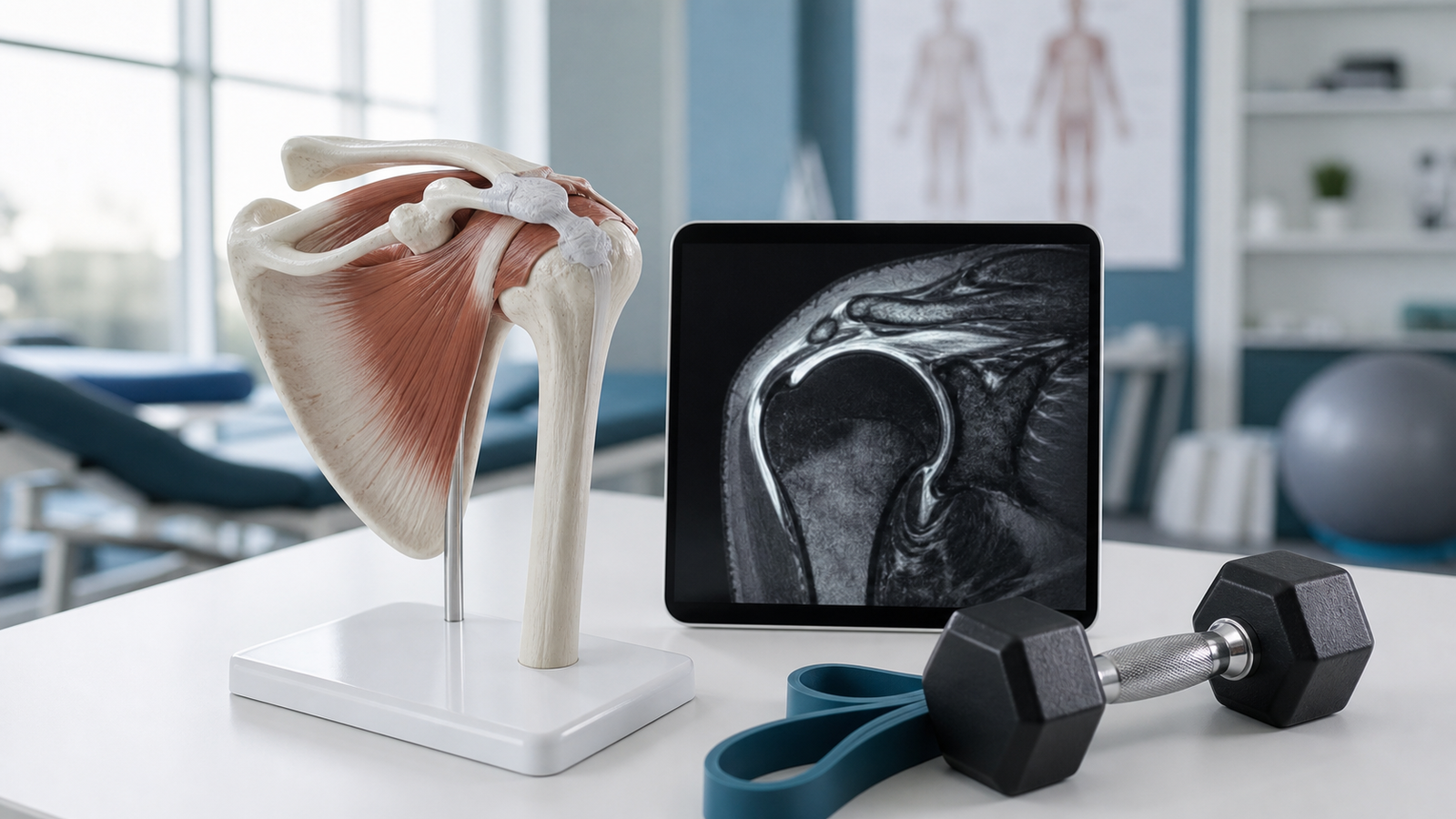
Shoulder pain while lifting weights is common, but it should not be dismissed as normal gym soreness. Pain during an overhead press, bench press, lateral raise, pull-up, or heavy row can arise from different structures inside the shoulder. Three frequently discussed possibilities are rotator cuff irritation or tearing, a labral injury, and shoulder impingement.
These conditions can produce overlapping symptoms, so the exercise that hurts is only a clue, not a diagnosis. The location of pain, whether weakness or clicking is present, how the problem started, and what happens after training all matter. A proper examination helps separate a temporary overload problem from an injury that needs imaging or targeted treatment.
Why weight training can expose shoulder problems
The shoulder provides exceptional movement because the upper arm sits in a relatively shallow socket. The rotator cuff muscles help centre the joint during motion, while the labrum deepens the socket and contributes to stability. During loaded pressing, pulling, or overhead work, these tissues must coordinate with the shoulder blade and upper back.
Pain may begin after a sudden failed repetition, an uncontrolled descent, lifting too heavy, or increasing training volume too quickly. It may also develop gradually from repeated overhead loading, poor shoulder-blade control, limited mobility, or training through fatigue. Technique matters, but pain is not always caused by bad form alone.
Rotator cuff pain or tear
The rotator cuff is a group of muscles and tendons that stabilise and rotate the shoulder. Irritation may cause pain over the front or outer side of the shoulder, especially when raising the arm, lowering a weight, reaching behind the back, or lying on the affected side. Night pain and weakness during overhead movement are useful warning signs.
A mild overload or tendinopathy may settle with activity modification and structured rehabilitation. A tear becomes more concerning when there is immediate weakness after an injury, difficulty lifting the arm, persistent night pain, or a clear loss of strength compared with the other side. The rotator cuff tear service page explains how clinical assessment and imaging guide treatment.
Could it be a labral injury?
The labrum is a ring of fibrous cartilage around the shoulder socket. Its upper part is connected to the biceps tendon. Weightlifters may irritate or injure the labrum through forceful overhead movement, traction on the arm, repetitive loading, or an instability event. Labral symptoms may include deep joint pain, painful clicking, catching, locking, reduced strength, or a feeling that the shoulder may slip.
Deep pain during bench press, dips, heavy curls, or overhead lifts can raise suspicion, but clicking alone does not prove a tear. Labral changes can also appear on scans without being the true pain source. Examination should consider shoulder stability, biceps involvement, training history, and whether there has been a previous dislocation. For instability-related labral damage, see the shoulder dislocation and Bankart lesion service page.
What shoulder impingement means
Shoulder impingement describes irritation where the rotator cuff tendons and nearby bursa become compressed or sensitive beneath the acromion as the arm is raised. Pain is often felt in the front or side of the shoulder and may be worse through a painful arc during lateral raises, upright pulling, or overhead pressing. Repeated overhead activity can aggravate it.
Impingement is closely connected with rotator cuff and bursal irritation rather than being a completely separate problem in every patient. The cause may involve load, tendon health, shoulder-blade movement, stiffness, or the shape of surrounding structures. Treatment should address the reason the area is overloaded, not simply avoid every overhead movement forever.
Clues from different gym movements
Bench press pain at the front of the shoulder may involve the rotator cuff, biceps tendon, labrum, or the acromioclavicular joint. Pain during lateral raises may fit rotator cuff or bursal irritation. Deep clicking during pressing or catching under load can point toward the labrum, while a sense of slipping or apprehension suggests instability.
These patterns overlap. Changing grip width or range may reduce symptoms but does not identify the injured tissue. Training videos, details about the first painful repetition, and the response over the following 24 hours can help the specialist understand the loading pattern.
When shoulder pain needs assessment
Stop heavy lifting and seek assessment if pain follows a fall, dislocation, sudden pull, or failed lift and is accompanied by immediate weakness. Review is also advisable for persistent night pain, repeated clicking with pain, loss of motion, visible deformity, numbness, instability, or symptoms that keep returning whenever training intensity increases.
Continuing to test a painful shoulder with heavy repetitions can increase irritation and hide true weakness behind compensation. A short reduction in painful loading is sensible, but complete rest for weeks without a plan can also lead to stiffness and deconditioning.
How the cause is diagnosed
Diagnosis begins with the history and physical examination. The specialist checks active and passive movement, rotator cuff strength, tenderness, shoulder-blade mechanics, stability, and specific positions that reproduce symptoms. The neck may also be examined because nerve irritation can mimic shoulder pain.
X-rays show bone alignment, arthritis, spurs, and acromioclavicular changes. Ultrasound can assess rotator cuff tendons dynamically, while MRI provides more detail about the cuff, labrum, biceps anchor, cartilage, and other soft tissues. An MR arthrogram may be considered for selected labral problems. Imaging findings must be matched with symptoms because not every scan abnormality requires treatment.
Treatment and return to lifting
Many overuse-related shoulder problems improve without surgery. Early care may include modifying painful lifts, reducing load or range temporarily, restoring movement, and strengthening the rotator cuff and shoulder-blade muscles. Return to lifting should be progressive, with pain response, control, range, and strength guiding each step.
Surgery may be discussed for a significant traumatic rotator cuff tear, recurrent instability, a symptomatic labral injury that has not improved with appropriate rehabilitation, or persistent structural damage affecting function. Treatment must match the exact injury and the patient's goals. Broader training-related assessment is available through sports injury care in Delhi.
How Dr Rahul Grover approaches weightlifting shoulder pain
Dr Rahul Grover assesses shoulder pain by combining the injury story, gym movement pattern, physical examination, and relevant imaging. The aim is to identify which tissue is actually causing symptoms, whether the shoulder is stable, and what level of training the patient wants to resume.
For athletes with a previous dislocation or repeated slipping, the article on shoulder instability after a first dislocation explains when early Bankart repair may be considered. A focused plan can help patients avoid random exercise changes and return to pressing, pulling, and overhead work more safely.
Conclusion
Shoulder pain while lifting weights may come from the rotator cuff, labrum, impingement-related irritation, or another nearby structure. Pain location and exercise patterns provide clues, but examination is needed when symptoms persist, strength falls, or the shoulder clicks, catches, or feels unstable.
Early assessment can clarify whether rehabilitation and load adjustment are sufficient or whether imaging and surgical planning are appropriate. The goal is not only to settle pain, but to restore confident shoulder function for training and daily life.

About Dr Rahul Grover
Dr. Rahul Grover is a highly respected orthopaedic surgeon known for advanced joint replacement, arthroscopy, spine care, fracture management, and sports orthopaedics.
Know More