Why Knee Pain After Running May Signal Meniscus, Cartilage, or Tracking Problems
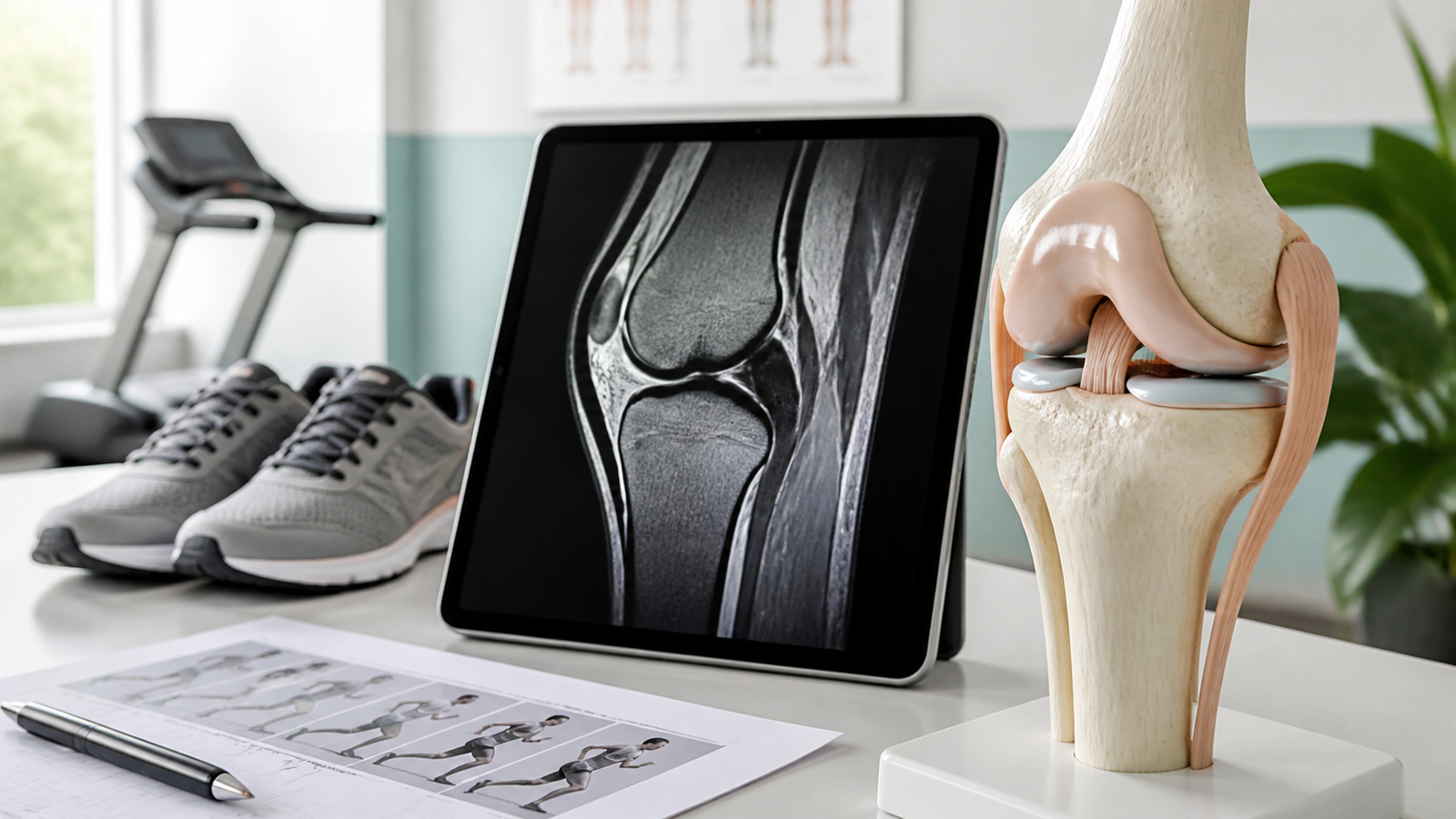
Knee pain after running is often blamed on weak muscles, hard roads, or worn-out shoes. Those factors can matter, but pain that returns on every run may also point to a problem inside the joint. The meniscus, articular cartilage, and the way the kneecap moves through its groove can each produce a different pattern of symptoms.
The useful question is not simply, “Is running bad for my knees?” It is where the pain occurs, when it starts, whether swelling follows, and whether the knee catches, locks, or feels unstable. These details help distinguish a manageable training-load problem from an injury requiring clinical assessment.
Why knee pain can appear after a run
Running repeatedly loads the knee while the hips, thigh muscles, calf, foot, and trunk control alignment. A sudden increase in distance, speed, hills, intervals, or running days can exceed the tissues' current capacity. Fatigue may also alter knee control late in a run. This can make an existing problem noticeable even when there was no single traumatic step.
Pain may appear during the run, immediately afterwards, or the next morning. A mild ache that settles quickly after an unusual increase in training is different from recurrent joint-line pain, visible swelling, or pain that changes normal walking. The response over the following 24 hours is often as informative as the pain felt while running.
Meniscus pain after running
The menisci are two wedge-shaped pads of fibrocartilage between the thighbone and shinbone. They distribute load, absorb shock, and contribute to knee stability. A meniscus tear may follow a twist or pivot, but degenerative tears can become symptomatic without a dramatic injury.
Meniscus-related pain is often felt along the inner or outer joint line. Swelling may develop gradually after activity, and the runner may notice catching, painful clicking, locking, difficulty fully straightening the knee, or a sense that it may give way. Deep squatting, turning, or running on uneven ground may aggravate symptoms.
Not every meniscus tear requires surgery. Symptoms, tear type, location, age, activity level, locking, and response to rehabilitation all influence treatment. Persistent mechanical symptoms or restricted motion deserve review. When intervention is considered, the aim is to preserve healthy meniscus tissue whenever possible.
Could articular cartilage be involved?
Articular cartilage is the smooth surface covering the ends of the bones inside the knee. A local cartilage defect may follow an injury, repeated overload, kneecap instability, or an underlying bone-and-cartilage condition. More widespread cartilage wear can develop over time, but focal defects can also affect younger active adults.
Cartilage-related symptoms may include a deep ache, recurrent swelling after impact activity, stiffness, grinding, catching, or reduced tolerance for distance. Pain may feel difficult to locate. A loose or unstable fragment can sometimes cause locking, although other knee structures can produce similar symptoms.
The severity seen on imaging does not always match pain. A small defect in a heavily loaded area may be very symptomatic, while another scan finding may be incidental. Alignment, meniscus condition, kneecap tracking, and the health of the bone beneath the cartilage are considered together.
Patellofemoral pain and kneecap tracking
Patellofemoral pain is commonly called runner's knee. It usually causes a dull ache around or behind the kneecap. Running, stairs, hills, squats, lunges, jumping, and sitting with the knee bent for a long time can increase symptoms. Some runners describe rubbing or harmless noise, while others feel painful grinding.
The kneecap moves through a groove at the lower end of the thighbone. Its movement is influenced by the shape of the joint, hip and thigh strength, flexibility, foot mechanics, training load, and control of the leg during landing. “Poor tracking” is therefore not one single diagnosis, and treatment should not rely only on taping or changing shoes.
Patellofemoral pain often improves with activity adjustment and progressive strengthening of the quadriceps, hip, and trunk. Running form or cadence changes may help selected runners, but they should be introduced gradually and matched to the individual's examination.
What the location and timing of pain can reveal
Pain around the kneecap that increases with stairs, hills, or prolonged sitting often fits patellofemoral overload. Pain precisely along the inner or outer joint line, especially with swelling or catching, raises concern about a meniscus. Deep pain with recurrent swelling may require assessment for cartilage or another internal joint problem.
Pain below the kneecap may come from the patellar tendon, while pain on the outside of the knee can also involve the iliotibial band. These patterns can overlap. Location narrows the possibilities, but examination is needed before attaching a diagnosis to a single symptom.
Warning signs runners should not ignore
Pause running and arrange assessment if the knee becomes visibly swollen, locks, repeatedly gives way, cannot fully bend or straighten, or remains painful during normal walking. A pop followed by rapid swelling, inability to bear weight, deformity, redness with fever, or severe pain after a fall requires prompt medical attention.
Recurring pain that returns at the same distance or intensity is also meaningful. Repeatedly resting until it settles and then resuming the same workload may create a cycle without addressing the cause.
How knee pain after running is assessed
Assessment includes training history, recent changes in distance or terrain, previous injuries, swelling pattern, pain location, and mechanical symptoms. The specialist examines alignment, range of motion, joint-line tenderness, kneecap movement, ligament stability, strength, and single-leg control. Running or squat mechanics may be reviewed when relevant.
X-rays can assess bone alignment, joint space, kneecap position, and arthritis. MRI shows the menisci, articular cartilage, ligaments, bone, and other soft tissues in greater detail. Imaging is most useful when interpreted alongside symptoms and examination findings rather than used as a diagnosis by itself.
Treatment and return to running
Initial treatment may include temporarily reducing running volume, avoiding painful hills or speed work, controlling swelling, and starting targeted rehabilitation. The programme may address quadriceps and hip strength, calf capacity, mobility, balance, and running load. Cross-training can maintain fitness if it does not increase symptoms.
Return to running should be progressive. Walking should be comfortable, swelling should be controlled, and strength and single-leg function should be improving before mileage rises. Increase one variable at a time so the knee's response can be judged clearly.
If persistent meniscus or cartilage symptoms do not improve, or the knee is mechanically blocked, arthroscopic treatment may be discussed. The knee arthroscopy service page explains how keyhole assessment and treatment may be used for selected internal knee problems. Runners can also seek a broader load and return-to-sport plan through sports injury care in Delhi.
How Dr Rahul Grover plans treatment
Dr Rahul Grover evaluates running-related knee pain by combining the training story, physical examination, functional testing, and appropriate imaging. The treatment plan is based on the structure causing symptoms, not on a generic label of runner's knee.
When a meniscus problem occurs alongside ligament instability, management and recovery can change. The article on ACL tear with meniscus injury explains why both structures may need to be considered together. For isolated running pain, the priority is to identify the cause early and restore durable capacity before chasing mileage.
Conclusion
Knee pain after running may reflect a temporary load mismatch, but it can also signal meniscus injury, cartilage damage, or patellofemoral tracking-related pain. Pain location, swelling, catching, locking, and the response after training help guide the next step.
Persistent or mechanical symptoms should be assessed rather than repeatedly trained through. With an accurate diagnosis, many runners can recover through targeted rehabilitation and gradual load progression, while selected structural problems may need arthroscopic or other specialist treatment.

About Dr Rahul Grover
Dr. Rahul Grover is a highly respected orthopaedic surgeon known for advanced joint replacement, arthroscopy, spine care, fracture management, and sports orthopaedics.
Know More