Partial ACL Tear in Active Adults: When Physiotherapy Works and When Surgery Is Needed
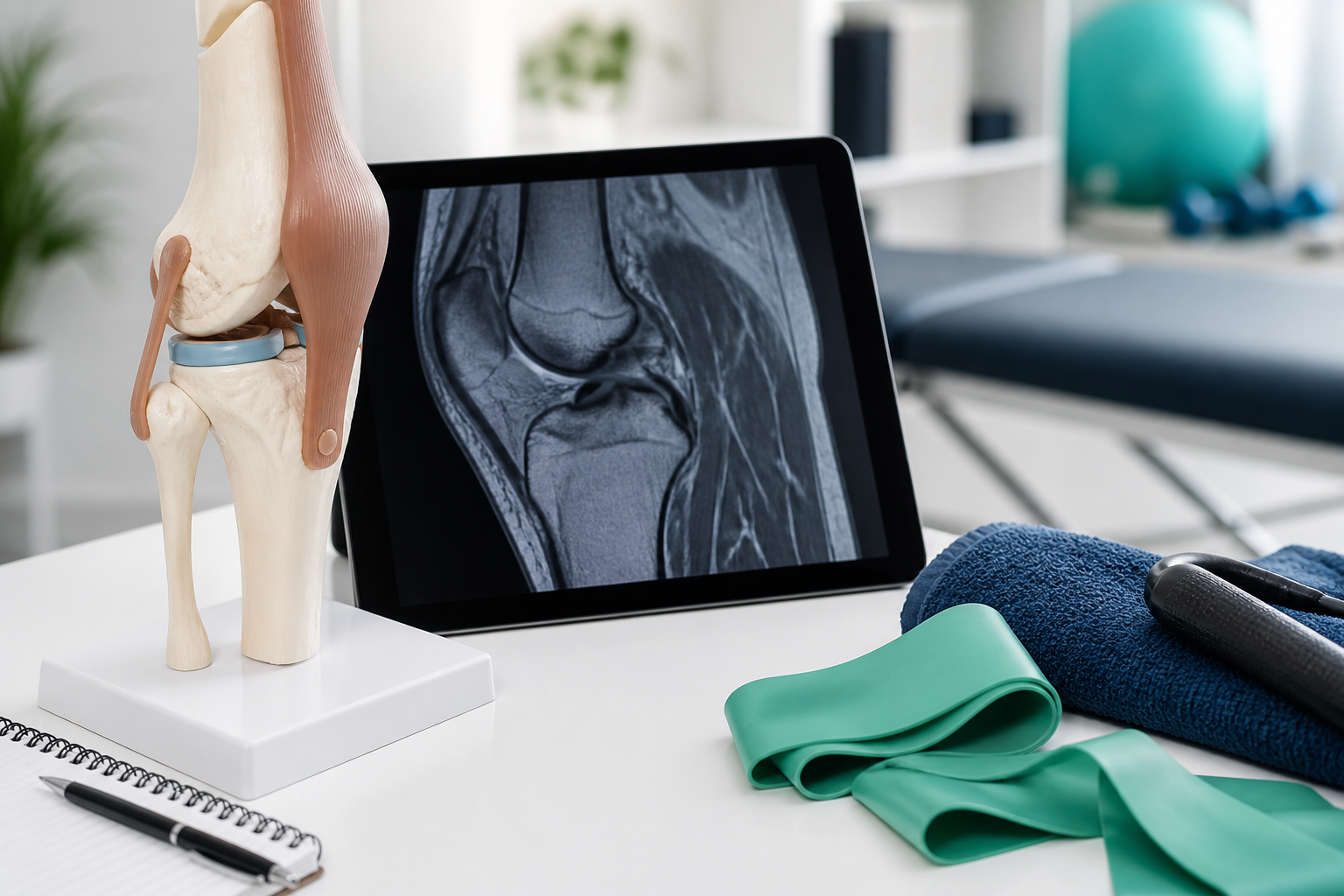
A partial ACL tear can be confusing for active adults. The MRI may say the ligament is not completely torn, yet the knee may still feel painful, swollen, weak, or unreliable. Some people recover well with physiotherapy, while others continue to feel the knee shift during running, pivoting, stairs, or sport. The key question is not only whether the ACL is partially torn, but whether the knee is functionally stable.
The anterior cruciate ligament, or ACL, helps control forward movement and rotation of the shin bone under the thigh bone. When only some fibres are injured, the remaining fibres may still provide useful support. That is why a partial ACL tear does not automatically mean surgery. But if the ligament cannot control rotation during activity, repeated giving-way episodes can damage the meniscus and cartilage.
What does a partial ACL tear mean?
A partial ACL tear means some ligament fibres are damaged while some remain continuous. The injury may happen during a sudden twist, awkward landing, rapid direction change, road traffic accident, or sports tackle. Symptoms may include swelling, pain, difficulty trusting the knee, reduced confidence during turns, and a feeling that the knee may buckle.
MRI helps identify the tear pattern, but it is only one part of the assessment. A knee can look partially torn on MRI and still behave unstable during examination. Another knee may look worrying on scan but remain stable for a patient with lower activity demands. This is why clinical testing and activity goals matter as much as the report.
When physiotherapy may work well
Physiotherapy may work well when the knee is stable, swelling settles, range of motion returns, and the patient does not experience giving-way episodes. It is especially suitable for people who are not involved in high-demand pivoting sports, or those whose daily activities do not repeatedly stress knee rotation. A structured programme usually focuses on swelling control, full knee extension, quadriceps activation, hamstring strength, hip control, balance, landing mechanics, and gradual return to activity.
Rehabilitation must be progressive, not random. Early exercises are different from return-to-running drills. The patient should be assessed for pain, swelling after exercise, strength difference between legs, single-leg control, and confidence during direction changes. If the knee remains quiet and stable as activity increases, non-surgical care may be successful.
Warning signs that physiotherapy may not be enough
Physiotherapy may not be enough if the knee repeatedly gives way, twists unexpectedly, swells after small activity, or feels unstable during sport-specific movement. Locking, catching, or joint-line pain may suggest a meniscus injury. A feeling of slipping during stairs, sudden turns, or getting off a bike also needs review.
Repeated instability is important because it can turn a partial injury into a bigger knee problem. Each giving-way episode may place extra load on the meniscus and cartilage. For active adults who want to return to football, cricket, basketball, kabaddi, running with cutting movements, or heavy gym training, a specialist evaluation helps decide whether continued rehabilitation is safe.
When surgery may be needed
Surgery may be considered when the partial ACL tear behaves like an unstable ACL injury. This includes recurrent giving way, high-grade laxity on examination, associated meniscus tear, cartilage injury, high-demand sports goals, or failed structured rehabilitation. The decision is individual. The aim is not to operate on every partial tear, but to protect the knee when instability is clearly present.
In many unstable ACL injuries, reconstruction is preferred to restore knee stability. The torn ligament is replaced with a graft, and associated injuries can be addressed during the same plan. You can learn more about surgical planning on the ACL tear and ACL reconstruction service page.
Role of knee arthroscopy and MRI
MRI is helpful for checking ACL fibres, bone bruising, meniscus tears, cartilage injury, and other ligament injuries. But the MRI report must be interpreted with the patient's symptoms. If instability is present, the scan helps plan treatment. If the knee is stable, it helps guide rehabilitation and follow-up.
Knee arthroscopy may be used when surgery is needed or when associated meniscus or cartilage injury requires treatment. It allows the surgeon to inspect the knee through small keyhole incisions and treat internal damage. For more on minimally invasive knee procedures, visit the knee arthroscopy service page.
Return to sport should be milestone-based
Returning to sport after a partial ACL tear should not depend only on time. It should depend on strength, control, swelling response, confidence, and sport-specific testing. A patient may feel good during walking but still be unsafe during cutting, pivoting, landing, or sudden deceleration.
Return should be gradual: walking without swelling, strengthening, balance work, straight-line running, controlled agility, non-contact drills, and then full sport if the knee passes functional checks. Sports patients should also understand training errors and prevention strategies through sports injury care.
How Dr Rahul Grover plans treatment
Dr Rahul Grover evaluates partial ACL tears with a stability-first approach. The assessment includes injury history, swelling pattern, physical examination, MRI review, activity goals, sport demands, and associated meniscus or cartilage findings. The treatment plan is then matched to the patient's knee, not just the wording of the MRI report.
Some patients are guided through structured physiotherapy and monitored return to activity. Others need surgical discussion because instability is already putting the knee at risk. If the ACL injury is combined with meniscus damage, the recovery plan may change. The article on ACL tear with meniscus injury explains why treating both problems together can matter.
Conclusion
A partial ACL tear in an active adult does not always need surgery. Physiotherapy can work well when the knee is stable, symptoms improve, and activity goals are compatible with non-surgical care. Surgery may be needed when instability continues, sport demands are high, or there is associated meniscus or cartilage injury.
If your knee gives way, swells after activity, feels unstable during turns, or you are unsure whether physiotherapy is enough, consult an orthopaedic sports injury specialist. Dr Rahul Grover provides evaluation and treatment for partial ACL tears, ACL reconstruction, knee arthroscopy, and sports knee injuries in Delhi.

About Dr Rahul Grover
Dr. Rahul Grover is a highly respected orthopaedic surgeon known for advanced joint replacement, arthroscopy, spine care, fracture management, and sports orthopaedics.
Know More