Silent Meniscus Tears: When Knee Clicking and Swelling Need MRI Review
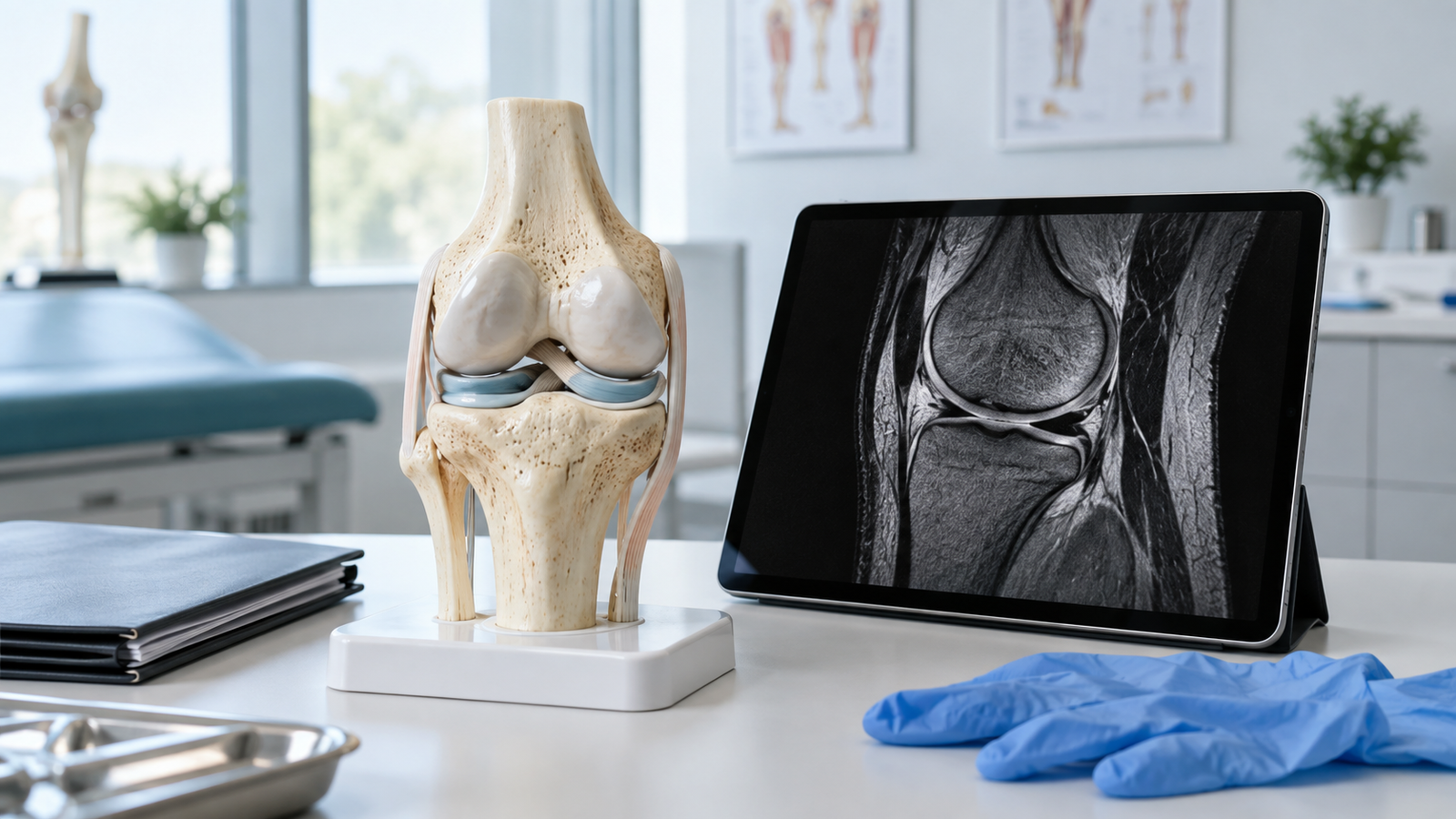
A meniscus tear does not always begin with a dramatic sports injury. Some tears develop gradually and remain quiet until the knee starts clicking, swelling after activity, or feeling uncomfortable during squatting and turning. Others are discovered on an MRI even though they are not responsible for the patient's symptoms. This is why the phrase “silent meniscus tear” needs careful interpretation.
The meniscus is important, but an MRI finding alone does not decide treatment. The most useful assessment combines the pattern of pain, swelling, mechanical symptoms, physical examination, X-rays when appropriate, and MRI findings. The goal is to identify whether the meniscus is actually causing the problem and whether it needs rehabilitation, observation, repair, or another treatment.
What is the knee meniscus?
Each knee contains two menisci: one on the inner side and one on the outer side. These C-shaped structures sit between the thighbone and shinbone. They distribute load, absorb shock, contribute to stability, and help protect the smooth articular cartilage covering the joint surfaces.
A meniscus can tear suddenly during a twist, pivot, deep squat, awkward landing, or contact injury. It can also weaken gradually with age and repeated loading. Degenerative tissue may tear during an ordinary movement such as rising from a low chair or turning while the foot remains planted.
Why some meniscus tears seem silent
Some tears cause little or no pain at first. A person may continue walking, working, or playing sport and notice only occasional clicking. In other cases, the tear is a coincidental MRI finding and another structure is causing the knee pain. Research has shown that meniscal abnormalities can be present in people without knee symptoms, particularly as age increases.
This does not mean every tear should be ignored. Tear pattern and displacement matter. A small stable degenerative change is different from a displaced fragment that blocks movement. Symptoms such as recurrent swelling, joint-line tenderness, painful catching, and loss of extension make the finding more clinically meaningful.
Is knee clicking always a meniscus tear?
No. Painless clicking can come from tendons moving, pressure changes within the joint, kneecap movement, or normal joint variation. Clicking becomes more concerning when it is new, painful, associated with swelling, or accompanied by catching, locking, or a feeling that the knee may give way.
A meniscus-related click is often felt close to the inner or outer joint line and may occur during twisting, deep bending, or straightening. However, no single sound or movement can confirm a tear. The knee must be assessed as a whole.
Why swelling after activity matters
Swelling indicates irritation inside or around the knee. With a meniscus problem, it may build over several hours after walking, running, stairs, sport, or repeated squatting. The knee can feel full, stiff, or difficult to straighten the next morning.
Swelling can also arise from cartilage injury, ligament damage, arthritis, inflammation, infection, or a fracture. Rapid swelling soon after a significant injury can suggest bleeding inside the joint and needs prompt assessment. Redness, warmth, fever, severe pain, or inability to bear weight also requires urgent medical attention.
Symptoms that make a meniscus tear more likely
Meniscus symptoms vary with the location and pattern of the tear. Common clues include pain directly along the inner or outer joint line, stiffness, recurrent swelling, pain during twisting or deep squatting, catching, and difficulty moving through the full range.
True locking is particularly important. This means the knee becomes physically blocked and cannot fully straighten or bend, rather than simply feeling painful or stiff. A displaced meniscus fragment can sometimes cause this mechanical block and should be assessed without delay.
A sense of instability may also occur, but giving way can result from pain, muscle inhibition, or ligament injury. If the original injury involved a pop, rapid swelling, or repeated buckling, the ACL and other structures should be examined as well.
When is an MRI review useful?
MRI provides detailed images of the menisci, ligaments, cartilage, tendons, bone, and other soft tissues. It is useful when the history and examination suggest an internal knee injury, symptoms persist despite appropriate initial care, or mechanical symptoms such as locking need clarification.
An MRI is not automatically the first test for every clicking knee. X-rays may be used first when arthritis, alignment, or bone problems are possible. If clicking is painless, there is no swelling, motion is full, and function is normal, immediate MRI may add little. Scanning without a clear clinical question can identify age-related findings that are unrelated to the complaint.
The scan should therefore be reviewed together with the patient, not treated as a standalone verdict. The specialist looks at the tear's type, size, location, displacement, tissue quality, associated cartilage damage, ligament stability, and whether the image matches the symptoms.
Does every meniscus tear need surgery?
No. Many stable or degenerative tears improve with activity modification, swelling control, and physiotherapy. Rehabilitation can restore movement, quadriceps and hip strength, balance, and confidence. Treatment also addresses the activities that repeatedly provoke the knee.
Surgery may be considered when the knee remains painful despite structured non-surgical treatment, a repairable traumatic tear affects an active patient, or a displaced tear causes locking or blocked motion. The decision should preserve as much healthy meniscus as possible because the tissue protects the knee's articular cartilage.
When surgery is appropriate, knee arthroscopy allows the surgeon to inspect the joint through small incisions. Depending on the tear, the meniscus may be repaired with sutures or an unstable damaged portion may be carefully trimmed. Repair usually requires a longer recovery because the tissue must heal.
Meniscus tears with ACL injury
A twisting sports injury can damage both the ACL and meniscus. In that situation, treating only the painful meniscus without recognising instability may leave the knee vulnerable to further damage. Examination and MRI review help define the complete injury pattern.
The article on ACL tear with meniscus injury explains why combined treatment planning can change rehabilitation and return-to-sport timelines. Athletes can also receive broader assessment through sports injury care in Delhi.
What to do while waiting for assessment
Avoid repeatedly testing the knee with deep squats, pivoting, or impact activity if these movements cause pain or swelling. Reduce the provoking load, use ice for short periods when swelling is present, and keep comfortable movement within the available range. Do not force a locked knee straight.
Record when swelling appears, where the pain is located, whether the knee catches, and what movement triggers the symptoms. These details can make the clinical review more useful. For runners whose symptoms appear mainly after mileage, the related guide on knee pain after running explains how meniscus, cartilage, and kneecap tracking patterns differ.
How Dr Rahul Grover evaluates suspected meniscus tears
Dr Rahul Grover assesses the mechanism of injury, pain location, swelling timeline, locking, instability, and activity goals. Examination includes knee movement, joint-line tenderness, meniscus tests, ligament stability, strength, alignment, and functional control. Imaging is selected when it will answer a specific clinical question.
The treatment plan is matched to the patient's symptoms and tear pattern. A quiet incidental MRI finding may need no direct procedure, while a repairable traumatic tear or mechanically blocked knee may need timely intervention. This symptom-to-scan correlation helps avoid both unnecessary surgery and delayed treatment of an important tear.
Conclusion
Silent meniscus tears can be subtle, but knee clicking alone does not prove that a tear is causing damage. Clicking becomes more meaningful when it is painful or occurs with joint-line pain, swelling, catching, locking, loss of motion, or instability.
MRI is valuable when symptoms and examination suggest an internal knee problem, but its findings must be interpreted in context. An orthopaedic evaluation can determine whether observation, physiotherapy, further imaging, or arthroscopic treatment is the right next step.

About Dr Rahul Grover
Dr. Rahul Grover is a highly respected orthopaedic surgeon known for advanced joint replacement, arthroscopy, spine care, fracture management, and sports orthopaedics.
Know More